Seeking a "yes, and" space
How the JSK Fellowship is putting me in a more generative culture.

Twenty-two years ago this month, I moved house.
I’d been living in Edinburgh, an ancient city whose gothic architecture cuts into an expansive sky. Even the air felt apart from the rest of the country: there was a different sort of chill to it, and it carried a malt smell from the breweries on the edge of town. When the train doors opened at Waverley Station, I didn’t just know I was home; I felt it on my skin and in my bones.
Edinburgh is famous for its support of the arts: the Festivals double the population of the city each summer. People fly in from all over the world to showcase their creativity and find new audiences. The city is alive.
But I had to leave.
I’d been working on Elgg, the open source social networking platform I co-founded. It was originally built as a reaction to the prevailing educational technology platforms, which seemed to have been built to satisfy compliance teams rather than to help anybody learn. People are already learning from each other on the web, was the implication. Let’s take those ideas and bring them in. Nobody had coined “Web 2.0” yet, but that’s what we were building: a way to support the informal learning and connection that happens in hallways, study rooms, clubs, and parties. Those relationships and conversations are what you really take away with you when you graduate, but they were completely absent from the prevailing software.
But the social headwinds were enormous. “It’ll never work here,” we were told, again and again. “Blogging is for teenage girls crying in their bedrooms,” one university leader memorably told us. We were in our early stages, looking for generative conversations, and they were hard to come by. In improv theater, there’s a yes, and rule that allows everyone to build on each other’s ideas without destroying the flow. A no, but response is conversation-ending punctuation: the generative energy has been terminated. But in Scotland, all we were getting was “no, but”. We were looking for optimistic creativity but could only find pessimism.
The difference in energy when I moved back to Oxford, my hometown, was night and day. I was able to find the yes, and energy I needed, and I felt less alone in trying to build something new. Elgg eventually powered networks for Ivy League universities, multinational corporations and NGOs, governments, and impactful social movements. None of it would have happened if I’d succumbed to the pessimism.
(It’s worth saying that Edinburgh has since established a robust innovation scene — and much of it is down to creating a cultural shift as well as simply providing infrastructure. Both help, but culture is key: it’s incredibly hard to create anything new if you’re being told none of it will work every day.)
Twenty-two years later, I’ve made another move — and I’m experiencing the same vibe shift.
There are one hundred and sixty-six Canary palms on Palm Drive, the long, straight road that leads to the oval that serves as the entrance to the Stanford campus. Every morning, I walk past each one. Every evening, I walk back. The sky is blue save for the low-flying planes coming in to land at SFO. Every few minutes, a Waymo self-driving car drives past me; more than once, a coyote or a hare has crossed my path.
This is home now.
A little over two weeks ago, I arrived on the Stanford campus. During the month of August, I moved out of my house and drove across country. The Pennsylvania forests and rolling hills of Appalachia gave way to cornfields, plains, salt flats, and mountains. Back home, my house was on the market. This isn’t a subtle move to a next chapter: it’s all change.
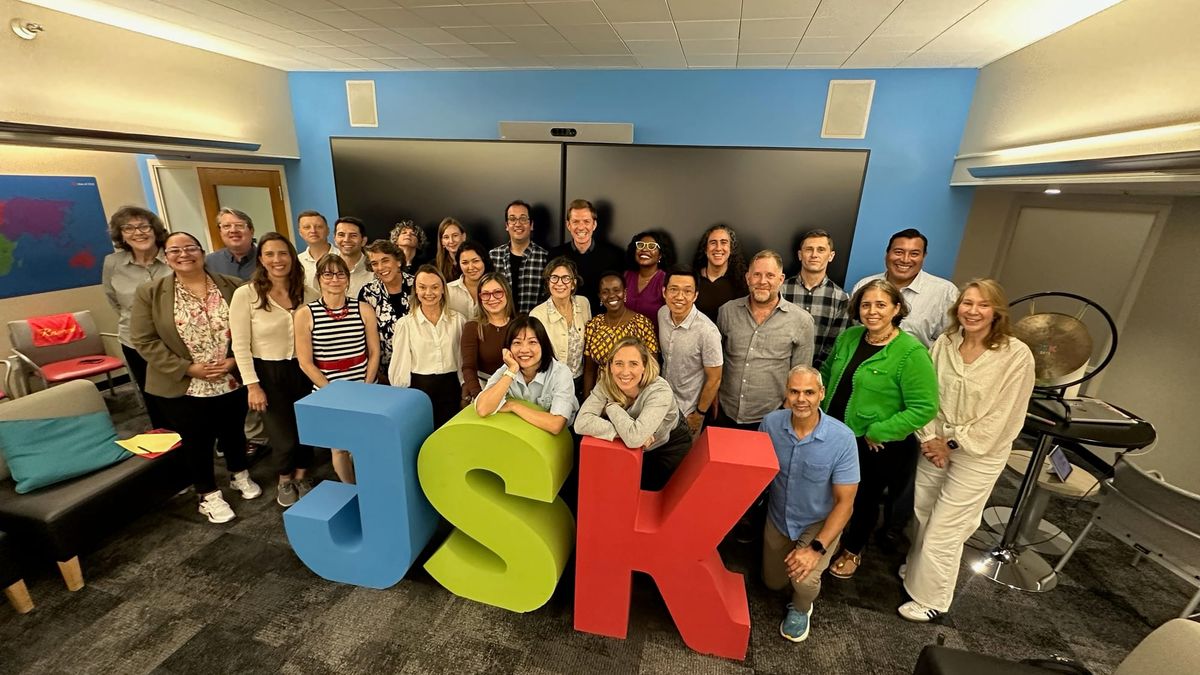
For the next academic year, I’ll be a JSK Fellow: part of a cohort of thirteen people invited to Stanford to explore and test out practical responses to the challenges facing journalists and journalism around the world. I’ll spend almost every day on campus, taking courses, visiting research labs, attending and hosting events, and connecting with people across disciplines and backgrounds.
Immediately, two things hit me. First: every single person in my fellowship cohort is inspiring. I get to share a room with people who have made enormous differences to their communities through their dedication to journalism, in places like Ukraine and Venezuela as well as here at home. The JSK staff are similarly impressive, with their own backstories of real impact. I feel very lucky to be in the room with them (and, inevitably, like a bit of an imposter).
Second: this is explicitly a yes, and space. The change in pressure and energy was palpable. And it couldn’t have come at a better time for me.
Newsrooms are under threat financially, politically, technically, and existentially. In that environment, it’s easy to become a no, but culture: when everything you do is scrutinized, the culturally safest thing to do is to take the conservative path. Decisions are made to iterate on the status quo rather than take leaps of faith. I’ve heard “this will never work here” as a thought-terminating statement at the early stages of a project’s ideation many times. When there are real changes, rather than innovate and do something new based on their community’s real needs, many newsrooms in the United States simply ask the question: “what is the New York Times doing?”
It’s understandable — the conditions that newsrooms are forced to work under are far from ideal — but it comes with a real cost, particularly when trust in journalism and loyalty to newsrooms are plummeting, in the fastest period of technology change (and therefore journalistic and democratic change) in decades. Real journalism provides the information and context that people need to make informed decisions, including who to vote for; it is part of the bedrock for a functioning democracy. As it happens, journalism’s decline is coinciding with democracy’s decline. We need new ideas that will serve our communities more effectively, and fast. Entrenching in the status quo or copying the Times won’t cut it.
And, speaking purely for myself, that widening gap between the immense, crucial need and what actions newsrooms are prepared to take can lead to burnout and learned helplessness. I badly needed a yes, and space.
It’s been two weeks. If the onboarding was the extent of my JSK experience it would be incredibly valuable: the mindset shift I desperately needed, and a set of tools that usefully reframe what I’ve been thinking about. But it’s a nine-month program, and there’s a lot more to come.
The need for innovation in news is not exactly new. When I first moved to the United States fifteen years ago, one of my first acts was to attend a design thinking session about the future of news at the Stanford d.School as part of Ben Huh’s Moby Dick Project. It foreshadowed everything that would happen next: I’ve been working on media innovation ever since, including for years at Matter, a media accelerator that was heavily rooted in the d.School’s methodology. We liked to quote the academic Clay Shirky, who wrote about the need for experimentation in the industry as the newspaper market started to bottom out with the phrase: “nothing will work, but everything might.”
Last week, I spent the day at the d.School again as part of my onboarding, and I felt that phrase resonating again. “Nothing will work, but everything might.” Let’s be generative.
Every JSK fellow applies with a question that they want to pursue. Here’s mine, as I originally framed it:
Trust in journalism is in long-term decline. Referrals to news articles from search engines and social media are also declining. There are many reasons for this. Google switching to AI-powered instant answers and seismic changes in incentives by the owners of prominent social media platforms are two commonly-stated causes, but they aren’t the whole story. It’s also true that many newsrooms didn’t understand or adapt to changes in how people want to interact with information that came about in the Web 2.0 era. Newsrooms still cling to a broadcast or publishing model rather than embracing conversation as a community of journalists and readers. People believe news is biased and shaped according to the needs of each newsroom’s corporate owners, but newsrooms don’t want to open up their process or add transparency for fear of becoming part of the story.
Most modern newsrooms live or die on the web, but the web is a conversation, not a broadcast medium, and newsrooms typically haven’t upgraded their thinking to fit. Helping them to build stronger human relationships with their communities — and each other — on the web will increase trust, loyalty, and resilience. And new community platform technologies like ATproto and ActivityPub could help provide building blocks for new kinds of news sites that elevate community and relationships to first-class parts of a newsroom’s work.
In the community-first software era, I expanded on where I might start with this idea:
Newsrooms rely on something called a “callout” when they want to learn more from their readers. More often than not, this is a simple web form: “Has your doctor pushed this prescription medication? Let us know.” But instead of a two-dimensional form, what if we built a short-term community space that safely brought readers in and allowed them to discuss in more depth with the journalists?
My bet is that two things will happen: the journalists will get better information, because it will arise in conversation, and those readers will build stronger, more transparent relationships with the newsroom. And stronger, more transparent relationships will lead to more trust and more loyalty.
It sounds plausible, right? And maybe it is. But in the process of discussing my idea with other fellows, through the genuinely excellent facilitation by Tran Ha and Jenn Brandel, I’ve realized I’ve skipped into solution-land without spending enough time on making sure I’ve framed the problem correctly.
I’ve been led by these beliefs:
- I believe that good journalism is a vital prerequisite for democracy: good contextual information allows us to make strong democratic decisions, including who to vote for, when to protest, where to spend our money, and how to use our voices.
- I also believe that many of our societal problems have been caused by platforms like X and Facebook that are so large that their owners can affect democratic discourse on a global scale, and that open protocols prevent anyone from having that much power.
- And finally, I believe that AI is abstracting us away from the human information sources that can provide real context and connection.
Those are genuine beliefs I hold. But they’re abstract, ideological ideas. The idea that journalism is important, or that AI has a distancing effect, doesn’t connect to someone who can’t find stories that represent their community or who has had to build an AI prompt to pull together actionable information because it was scattered. The idea that open protocols are better doesn’t speak to someone who needs to share information with their community in a safer way because they’re under attack on incumbent platforms.
These things are hard to explore when you’re a part of an existing organization, with its own culture, norms, rhythms, and risks. Here, I’m not Ben Werdmuller, Senior Director of Technology at ProPublica (or CTO at The 19th, Director of Investments at Matter, Co-founder of Elgg, etc) — I’m a fellow with a mandate to explore independently. I don’t need to be restricted by an organizational context; I can sit with the problem in my own time and space. It’s a gift.
For my project, my first task is to learn more about the ecosystem I want to help. Which communities should I start with? What are their characteristics? What are their needs? Who are the newsrooms that serve them today?
As a human, my task is also to fully break out of a reactive, iterative mindset and into one of holistic exploration. How can I serve my own mind, body, and spirit so that I can work on these problems to the best of my ability? How can I learn from my fellowship cohort and the incredible people on the Stanford campus? How can I show up for them so that we can support each other’s work and each make the impact we set out to achieve? And how can I embrace my own inner yes, and?
That’s my mission at the start of this year. I’m going to take you with me — and I hope to be in conversation with many of you as I progress. Let’s work on this together.